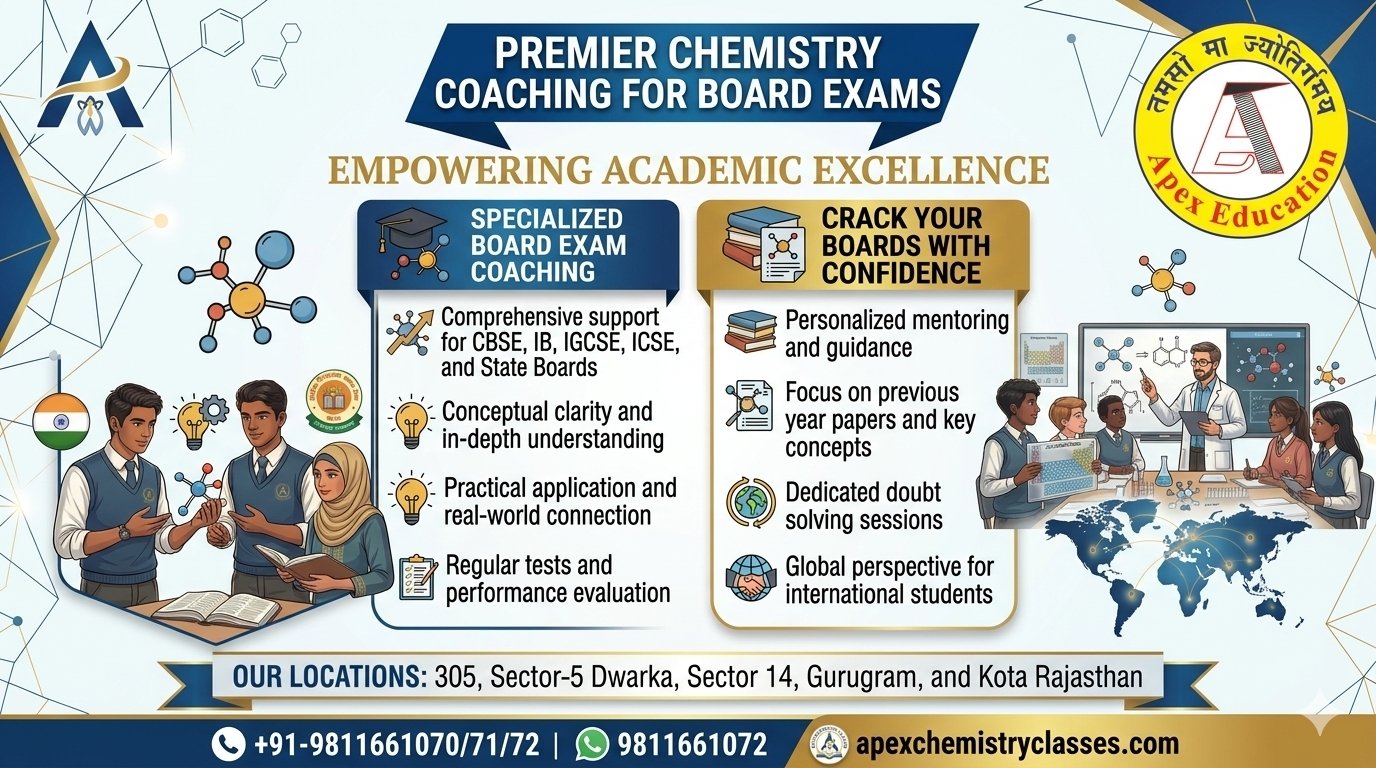
Top Global Educational Boards Guide | Class 10 & 12 Chemistry Coaching
Comprehensive guide to CBSE, IB, IGCSE, AP & global boards. Get premier chemistry coaching/tuition for JEE, NEET & academic standards in Gurugram, Chanakyapuri & Delhi NCR by Ashok Sir. Money-back guarantee program available!
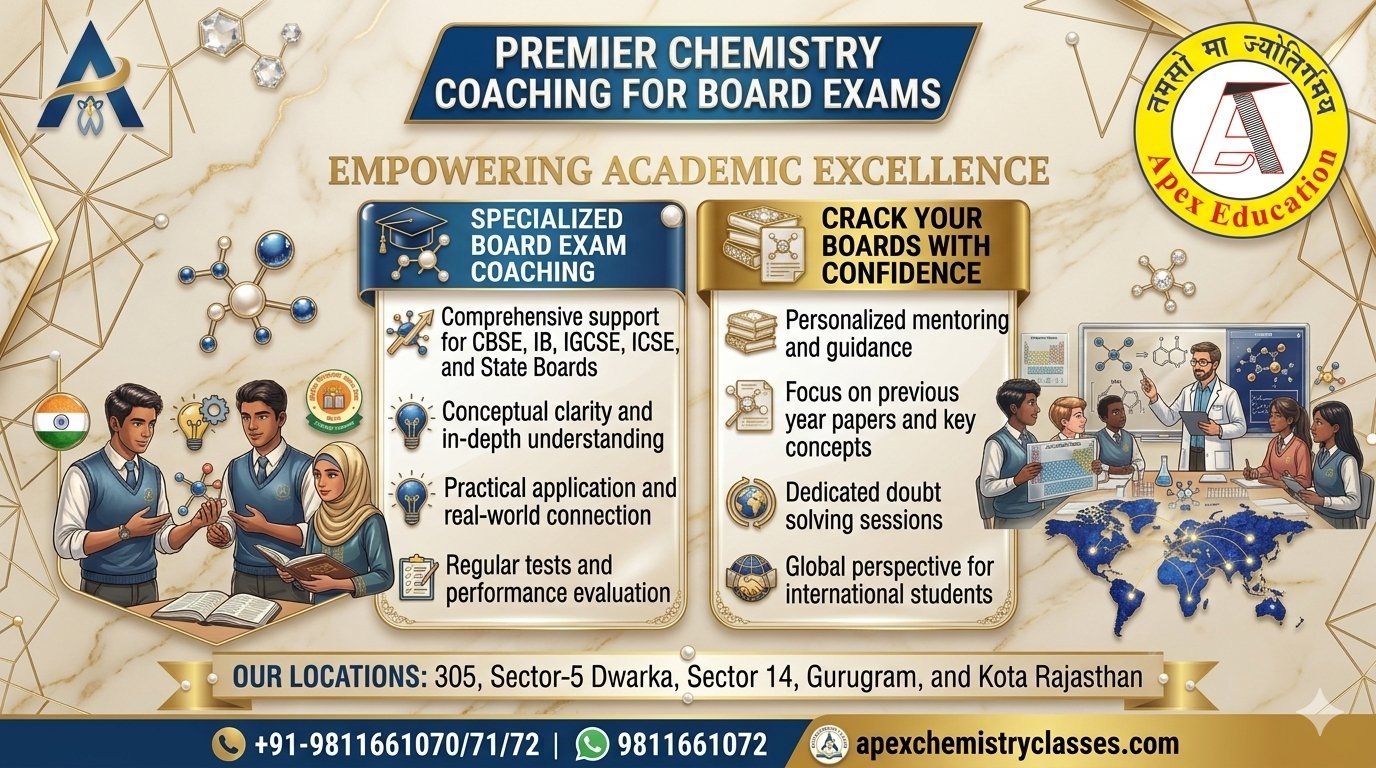
Comprehensive Guide to Global Secondary and Senior Secondary Educational Boards: Navigating Class X and XII Evaluation Systems Worldwide
Choosing the right educational board for Class X (Secondary) and Class XII (Senior Secondary) education is one of the most critical milestones in a student’s academic journey. The curriculum, assessment methodologies, and conceptual depth of these boards directly shape university placements, engineering or medical entrance outcomes, and long-term career trajectories.
As a global educational hub, Apex Chemistry Classes provides unmatched conceptual clarity across every major national and international educational board. Recognized as the premier chemistry classes/ Coaching/ tuition for JEE, NEET and Academic standard , we bridge the gap between classroom board curricula and competitive testing benchmarks. Whether you are navigating the structured syllabi of Indian national boards or the analytical frameworks of international certification systems, this definitive guide provides a deep-dive analysis of secondary and senior secondary boards across India, the Gulf, Asia, Western countries, Europe, and the rest of the world.
1. Educational Boards in India: National & State Frameworks
India’s secondary and senior secondary education ecosystem is highly structured, divided between powerful central jurisdictions and region-specific state boards. These frameworks form the operational foundation for engineering (JEE Main & Advanced ) and medical (NEET-UG ) entrance examinations.
Central Board of Secondary Education (CBSE)
- Secondary Metric: All India Secondary School Examination (AISSE) – Class X
- Senior Secondary Metric: All India Senior School Certificate Examination (AISSCE) – Class XII
- Overview: Headquartered in New Delhi, CBSE is India’s foremost national educational board, governing thousands of public and private schools across the nation and within expatriate enclaves globally.
- Chemistry Core & Syllabus Design: The CBSE chemistry curriculum strictly follows the NCERT (National Council of Educational Research and Training) textbook design. Divided into Physical, Organic, and Inorganic Chemistry, the syllabus prioritizes factual precision, clear chemical nomenclature, structured numerical problems, and basic laboratory experiments.
- Entrance Exam Alignment: Because JEE and NEET parameters are set by national testing agencies that utilize NCERT books as their baseline, CBSE students possess an inherent alignment with these competitive national exams.
Council for the Indian School Certificate Examinations (CISCE)
- Secondary Metric: Indian Certificate of Secondary Education (ICSE) – Class X
- Senior Secondary Metric: Indian School Certificate (ISC) – Class XII
- Overview: Established as a private, non-governmental national board, CISCE is renowned for its intensive focus on English language proficiency, experiential learning, and deep conceptual exploration.
- Chemistry Core & Syllabus Design: The ISC Class XI and XII Chemistry curriculum is frequently considered broader in scope than CBSE. It introduces advanced chemical thermodynamics, elaborate organic reaction mechanisms, and extensive qualitative/quantitative laboratory analyses at an earlier stage.
- Entrance Exam Alignment: While highly rigorous, ISC students must adapt their comprehensive knowledge base to match the objective, speed-driven testing formats of JEE and NEET.
State Boards of Secondary and Higher Secondary Education
- Key Implementers: Maharashtra State Board (MSBSHSE), Uttar Pradesh Board (UPMSP), Telangana/Andhra Pradesh Board (BIEAP), West Bengal Council (WBCHSE), and others.
- Overview: Each Indian state operates its independent educational board to cater to regional linguistic and historical demographics.
- Chemistry Core & Syllabus Design: Over the past decade, major State Boards have progressively aligned their senior secondary science syllabi with the National Curriculum Framework (NCF) to ensure parity with CBSE. However, variations persist in evaluation patterns, balancing descriptive, long-form questioning with regional state-level entrance frameworks (e.g., MHT-CET, WBJEE).
2. Educational Ecosystems in the Gulf / GCC Region
The Gulf Cooperation Council (GCC) countries—including the United Arab Emirates (UAE), Saudi Arabia, Qatar, Oman, Kuwait, and Bahrain —host massive South Asian and western expatriate populations.
Indian Expatriate Curriculum Network (CBSE Gulf Gulf Chapter)
- Overview: To support the massive Indian diaspora, hundreds of premier schools across Dubai, Abu Dhabi, Riyadh, Doha, and Muscat operate under the CBSE Gulf Chapter .
- Characteristics: These institutions follow the exact academic timelines, examination protocols, and NCERT-centric evaluations mandated by New Delhi.
- The Competitive Challenge: Expatriate students in the Gulf frequently target competitive seats in Indian IITs, NITs, and government medical colleges through the DASA (Direct Admission of Students Abroad) or CIWG (Children of Indian Workers in Gulf) quotas. This creates an urgent demand for elite conceptual mentoring that balances local Gulf school schedules with rigorous Indian entrance testing metrics.
Ministry of Education (MoE) Local Frameworks
- Overview: Local public school tracks in GCC nations follow state-centric Arabic or English-medium frameworks managed by individual ministries.
- Characteristics: Science programs emphasize regional industrial operations, such as petrochemical engineering dynamics, requiring adaptive tutoring models for students moving into global university tracks.
3. Educational Boards in Asian Countries (Non-India)
Asia’s leading educational jurisdictions are globally praised for their strict academic discipline, deep analytical assessment metrics, and mathematical rigor.
Singapore-Cambridge GCE O-Level and A-Level
- Secondary Metric: Singapore-Cambridge GCE Ordinary Level (O-Level)
- Senior Secondary Metric: Singapore-Cambridge GCE Advanced Level (A-Level)
- Overview: Managed collaboratively by the Ministry of Education (MOE) Singapore and Cambridge International Examinations (CIE) , this represents one of the world’s most academically demanding secondary tracks.
- Chemistry Core & Syllabus Design: The H1, H2, and H3 blocks of Singapore A-Level Chemistry diverge from standard memorization. The curriculum centers heavily on structural chemistry, complex electrochemistry, transition metal behaviors, and highly advanced analytical spectroscopy. Evaluation relies on critical hypothesis-testing and multi-step data interpretation.
Malaysia: Sijil Tinggi Persekolahan Malaysia (STPM)
- Overview: The STPM is a pre-university sixth-form evaluation equivalent to the British A-Levels and validated by Cambridge assessment.
- Chemistry Focus: Operates on a rigid modular framework testing advanced physical states, organic synthesis maps, and industrial materials chemistry.
East Asian High-Stakes Matrix (The Gaokao & CSAT frameworks)
- Overview: China’s Gaokao and South Korea’s CSAT (Suneung) represent national high-stakes examinations that serve simultaneously as graduation validations and university placement metrics.
- Chemistry Focus: Science sections demand rapid, error-free execution of advanced stoichiometric models, complex chemical equilibria calculations, and sophisticated thermodynamic evaluations.
4. Educational Boards in Western Countries (Americas & Oceania)
Western secondary education emphasizes individualized student pathways, continuous internal assessments, and specific elective acceleration modules.
United States of America: High School Diploma & Advanced Placement (AP)
- Standard Framework: The US High School Diploma relies on localized district standards and the Common Core State Standards Initiative .
- The AP System: Administered by the College Board , the Advanced Placement (AP) program allows high schoolers to complete college-level coursework.
- AP Chemistry Core: AP Chemistry focuses on big-picture conceptual ideas, including atomic structures, chemical intermolecular forces, thermodynamics, reaction kinetics, and complex chemical equilibria. The evaluation balances a strict multiple-choice section with multi-part Free Response Questions (FRQs) designed to test laboratory methodology and data deduction. Excellent AP Chemistry scores secure direct university credit exemptions globally.
Canada: Provincial Secondary School Diplomas
- Key Implementers: Ontario Secondary School Diploma (OSSD), British Columbia Certificate of Graduation (Dogwood Diploma).
- Chemistry Focus: Canada lacks a singular central national board. Provincial curricula balance continuous project portfolios with targeted final exams, emphasizing the societal, environmental, and technological impacts of green chemistry.
Australia: Senior Secondary Certificates of Education
- Key Implementers: Victorian Certificate of Education (VCE), New South Wales Higher School Certificate (HSC).
- Chemistry Focus: Highly structured, modular systems evaluating chemical design pathways, green energy configurations, industrial efficiency processes, and modern biochemical frameworks.
5. Educational Boards in Europe and the United Kingdom
European secondary education values historical academic depth, absolute technical specialization, and oral/written presentation mastery.
United Kingdom: Cambridge Assessment International Education (CAIE) & Pearson Edexcel
- Secondary Metric: International General Certificate of Secondary Education (IGCSE) / GCSE
- Senior Secondary Metric: International AS & A-Levels
- Overview: British qualifications are widely recognized globally, serving as standard entrance baselines for elite academic institutions across Europe, North America, and Asia.
- Chemistry Core & Syllabus Design: A-Level Chemistry demands an advanced understanding of physical, inorganic, and organic chemistry concepts. Assessment modules require students to explain structural anomalies via atomic configurations, map complex organic reaction mechanisms, and demonstrate rigorous data analysis skills on practical testing papers.
Germany: The Abitur
- Overview: Awarded at the conclusion of German secondary school (Gymnasium ), the Abitur serves as a direct qualification for university entrance.
- Chemistry Focus: Standard courses (Grundkurs ) and advanced focus blocks (Leistungskurs ) evaluate complex macromolecular biochemistry, chemical plant energetics, and chemical equilibrium kinetics through rigorous, long-form written and oral assessments.
France: Le Baccalauréat (The French Bac)
- Overview: Established under Napoleon I, this iconic national diploma requires specialization tracks within the senior secondary tier.
- Chemistry Focus: The Spécialité Physique-Chimie demands deep mathematical integrations to solve advanced quantum mechanics problems, complex acid-base dynamics, and spectrophotometric tracking models.
6. Transnational Frameworks: The International Baccalaureate (IB)
Operating independently of any individual sovereign nation, the International Baccalaureate (IB) is considered one of the premier pre-university tracks globally.
IB Diploma Programme (IBDP) – Ages 16 to 19
- Overview: Headquartered in Geneva, Switzerland, the IBDP is a rigorous, holistic two-year educational framework utilized by top private and international schools worldwide.
- Chemistry Core & Syllabus Design: Chemistry is offered at both Standard Level (SL) and Higher Level (HL) within Group 4 (Experimental Sciences).
- IB Chemistry HL is exceptionally comprehensive, covering advanced quantum theory, thermodynamic cycles, transition metal complexes, chemical kinetics mechanisms, and sophisticated spectroscopic determination (NMR, IR, Mass Spectrometry).
- Assessment Architecture: Evaluation goes far beyond simple test papers, combining external examinations with an intensive Internal Assessment (IA) —an individual, 3,000-word scientific research project based on original laboratory investigation. Students must also connect their knowledge to the Theory of Knowledge (TOK) framework, assessing how scientific knowledge is constructed and validated.
Cross-Board Chemistry & Structural Equivalency Matrix
| Geography / Board | Secondary Qualification (Class X Equiv.) | Senior Secondary Qualification (Class XII Equiv.) | Primary Chemistry Curricular Focus | National Entrance / Global University Alignment |
|---|---|---|---|---|
| India: CBSE | AISSE (Class X Exam) | AISSCE (Class XII Exam) | NCERT-centric, balanced theory, conceptual naming, formula metrics. | Direct baseline match for JEE Main/Advanced and NEET-UG . |
| India: CISCE | ICSE | ISC | Expanded experimental theory, early organic synthesis pathways. | Strong foundations for Indian entrance exams; highly valued globally. |
| Transnational: IB | MYP (Middle Years Programme) | IB Diploma Programme (SL / HL) | Experimental design, internal research (IA), spectroscopic analysis. | Preferred by elite global universities (Ivy League, Oxbridge). |
| United Kingdom | IGCSE / GCSE | International AS & A-Levels | Analytical mechanism maps, structural anomalies, practical papers. | Direct entry for UK/EU universities; widely accepted globally. |
| United States | High School Credit | Advanced Placement (AP) Chemistry | Big-picture concepts, molecular interactions, free-response data analysis. | Secures US university credits and exemptions. |
| Singapore | GCE O-Level | GCE A-Level (H1 / H2 / H3) | Highly advanced physical kinetics, transition metals, data reasoning. | Baseline for top Asian and UK engineering programs. |
7. Advanced Higher Education Integration: Graduation Level Chemistry
The transition from a secondary board to professional university programs introduces a massive leap in conceptual complexity. Many students face significant academic pressure during their initial semesters in professional science and medical tracks due to gaps in their foundational understanding.
At Apex Chemistry Classes , our pedagogical expertise extends beyond school curricula. We provide specialized, advanced instruction for university graduation tiers worldwide:
- B. Tech (Engineering Chemistry): Comprehensive support for major technical university programs. Instruction focuses on polymer science, advanced electrochemistry for energy storage, molecular spectroscopy, chemical thermodynamics, water treatment engineering, and nano-materials.
- B. Sc. (Honours / Pass Course): Rigorous support for core university science tracks. We provide comprehensive instruction across physical chemistry, inorganic synthesis, structural organic reaction mechanisms, quantum chemistry, and advanced laboratory techniques.
- MBBS & BDS (First-Year Biochemistry & Foundations): Specialized guidance for medical and dental students navigating complex biochemical pathways. Instruction covers enzyme kinetics, metabolic pathways (glycolysis, Krebs cycle, oxidative phosphorylation), molecular biology fundamentals, and clinical chemistry applications.
Whether you are studying under local Indian university guidelines or global international university frameworks, our advanced programs ensure students maintain excellent academic standings and high GPAs.
8. Premium Localized Coaching: Serving Gurugram, Chanakyapuri, and Delhi NCR
For families seeking elite academic guidance, access to high-quality personalized coaching is essential. Apex Chemistry Classes delivers world-class chemistry instruction directly to your neighborhood, offering specialized programs across key hubs in the national capital region:
- Premium Chemistry coaching for IB, CBSE, others in Gurugram, Chanakyapuri and Delhi NCR: Designed for students who require a refined learning environment that balances school schedules with competitive exam preparation.
- Best Chemistry coaching for IB, CBSE, others in Gurugram, Chanakyapuri and Delhi NCR: Utilizing advanced teaching technologies, customized study resources, and highly optimized lesson planning.
- Top Chemistry coaching Classes for IB, CBSE, others in Gurugram, Chanakyapuri and Delhi NCR: Recognized as a premier coaching institute with a consistent track record of top ranks in board exams, JEE, and NEET.
- Expert Chemistry tutor for IB, CBSE, others in Gurugram, Chanakyapuri and Delhi NCR: Offering personalized, individual guidance tailored to a student’s specific academic needs, learning speed, and target goals.
Our physical centers and hybrid digital platforms are structured to support both local national board students and international learners navigating the complex calendars of IB and Cambridge tracks.
9. Faculty Spotlight: Ashok Kumar Yadav (Ashok Sir)
The core driver behind the academic success at Apex Chemistry Classes is our visionary founder and lead educator, Ashok Kumar Yadav (Ashok Sir) .
Visionary Pedagogy & Methodology
With over two decades of dedicated teaching experience, Ashok Sir has developed a unique pedagogical approach that transforms how students learn chemistry. His teaching style rejects passive rote memorization, focusing instead on developing a deep, intuitive understanding of chemical principles.
- Deconstruction of Complex Concepts: Ashok Sir breaks down highly abstract theories—such as orbital hybridization, thermodynamic state functions, and complex organic mechanisms—into simple, logical, and step-by-step conceptual blocks.
- Proprietary Problem-Solving Frameworks: Students learn specialized shortcut matrices, structural visualization techniques, and advanced elimination methods that are critical for managing time constraints during JEE and NEET exams.
- Comprehensive Mentorship: Beyond standard lectures, Ashok Sir provides personalized academic tracking, stress management strategies, and dedicated guidance to help students build confidence and maintain peak mental performance during high-stakes exams.
His signature teaching style transforms chemistry from a subject to be memorized into a logical, highly engaging science where students learn to derive reactions from foundational principles. This approach has helped thousands of students secure top ranks in JEE, NEET, and international board examinations globally.
10. Ultimate Academic Accountability: The Money-Back Guarantee Program
At Apex Chemistry Classes, we believe exceptional education must be paired with complete institutional accountability. To reflect our commitment to student success, we offer our industry-leading Money-Back Guarantee Program —a bold standard of educational quality.
How the Guarantee Functions
We are fully committed to the academic growth of our students. If a student fulfills their foundational academic responsibilities but does not see a measurable improvement in their overall performance metrics, Apex Chemistry Classes will refund the tuition fees according to our transparent policy guidelines.
Core Eligibility Guidelines
To maintain the integrity of the program, eligibility relies on a shared commitment to academic discipline:
- Attendance Consistency: The student must maintain a minimum attendance threshold of 90% across all scheduled lectures, revision modules, and mandatory laboratory simulations.
- Assignment Compliance: The student must complete and submit at least 95% of assigned homework, structural worksheets, and topic-wise practice modules on time.
- Assessment Participation: The student must participate in all periodic mock evaluations, board simulation exams, and diagnostic tests, demonstrating genuine effort across all evaluation cycles.
When a student brings dedication to their studies, Ashok Sir and our specialized faculty ensure they achieve the conceptual clarity needed to excel. This program is our clear promise that your investment in your child’s education is backed by proven academic accountability.
Conclusion: Securing Global Chemistry Excellence
Navigating the diverse requirements of global educational boards can feel overwhelming. Succeeding in these programs requires more than just memorizing facts—it demands a deep, structural understanding of chemical sciences. Whether your goal is mastering an IB Internal Assessment in Chanakyapuri , excelling on the CBSE board exams in Gurugram , scoring a perfect 5 on an AP Chemistry exam , or securing a top rank in JEE or NEET , Apex Chemistry Classes provides the expert guidance you need.
Under the direction of Ashok Sir , we provide the specialized resources, conceptual clarity, and proven strategies needed to succeed across any educational board worldwide. Invest in a learning program built on absolute clarity, academic excellence, and proven results.