IB Board Guide: Curricular Structure, Diploma & Coaching | Apex Chemistry
Detailed guide to the International Baccalaureate (IB) framework, its core components (TOK, EE, CAS), and evaluation metrics. Get premium chemistry coaching for IB and competitive exams in Gurugram, Chanakyapuri & Delhi NCR by Ashok Sir.
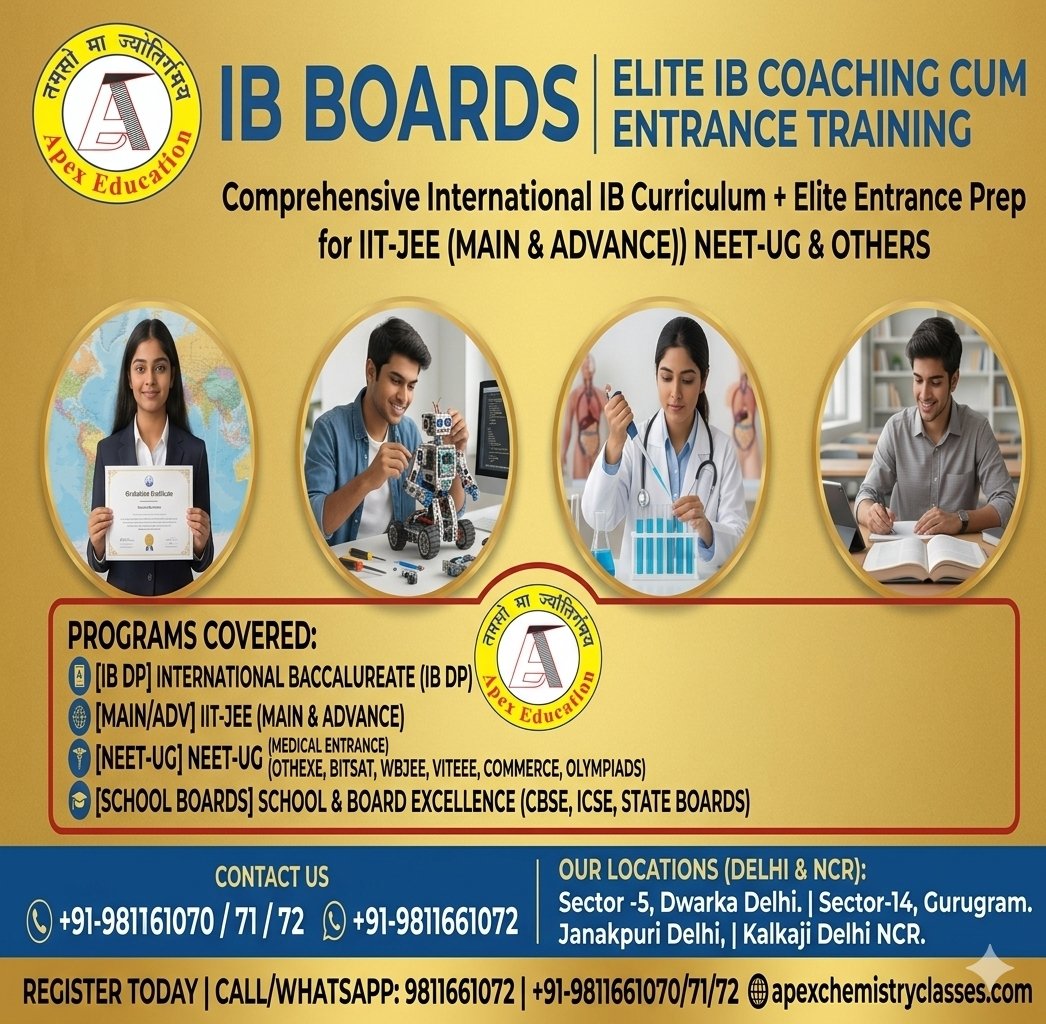
The Definitive Guide to the International Baccalaureate (IB) Board: Educational Philosophy, Curricular Architecture, and Global Academic Dominance
The landscape of international secondary and senior secondary education has experienced a profound paradigm shift over the last few decades. Increasingly, discerning families and forward-thinking educators are moving away from traditional, localized national models toward holistic, inquiry-driven, and cross-border pedagogical frameworks. Standing at the absolute pinnacle of this global educational movement is the International Baccalaureate (IB).
Operating as an independent, non-profit educational foundation headquartered in Geneva, Switzerland, the IB offers an elite suite of academic programs that span a student’s entire schooling lifecycle. Known for its demanding continuous internal evaluations, critical research demands, and transdisciplinary worldview, the IB curriculum has established itself as the gold standard of pre-university education. It is uniquely respected by elite universities worldwide—from the Ivy League in the United States to Oxbridge in the United Kingdom and top-tier institutions across India.
For students pursuing advanced STEM paths, the conceptual depth of the IB curriculum is unmatched. However, navigating the intersection of an international curriculum with high-stakes competitive benchmarking requires an exceptional degree of academic guidance. At Apex Chemistry Classes, we deliver highly specialized, logic-driven academic support that translates abstract international models into clear, high-scoring execution. Recognized as the premier chemistry classes/ Coaching/ tuition for JEE, NEET and Academic standard, our pedagogy ensures that students bridge the gap between rigorous internal investigations and high-speed objective testing.
Beyond secondary systems, we provide advanced chemistry coaching for graduation levels—including B. Tech, B. Sc., BDS, MBBS, and equivalent qualifications in India and across the globe. Whether your child is balancing the Diploma Programme’s core requirements or targeting elite competitive ranks, our infrastructure supports their complete educational lifecycle.
1. History, Ethos, and the Visionary Mandate of the IB Board
Founded in 1968 in Geneva, Switzerland, the International Baccalaureate was originally created by a visionary group of international school educators to solve a practical dilemma. Globally mobile families—such as diplomats, international business professionals, and research scholars—frequently struggled with shifting international school borders. Their children were constantly forced to adapt to disparate regional testing calendars, localized historical biases, and misaligned university recognition standards.
      Inquiry-Led Learning Framework (1968 - Geneva, Switzerland)
                                  │
                                  ▼
      Holistic Development of the IB Learner Profile
                                  │
                                  ▼
     Global Recognition across Elite Transnational Universities
The founders of the IB sought to construct a curriculum that was entirely free from any single sovereign nation’s political or cultural biases. They created a rigorous, balanced, and globally recognized pre-university validation system that values how to think over what to think.
Today, the IB is guided by a profound, progressive mission statement: to develop inquiring, knowledgeable, and caring young people who help to create a better and more peaceful world through intercultural understanding and respect. The core of this ethos is captured in the IB Learner Profile, which challenges students, educators, and schools to strive to be:
- Inquirers & Knowledgeable: Nurturing natural curiosity, conducting rigorous scientific research, and exploring conceptual ideas across local and global contexts.
- Thinkers & Reflective: Applying critical and creative thinking skills to analyze complex, open-ended problems, while thoughtfully considering their own learning experiences and limitations.
- Principled & Open-Minded: Acting with integrity, a strong sense of justice, and deep respect for the histories, values, and cultural identities of communities worldwide.
- Communicators, Caring, Risk-Takers, and Balanced: Mastering expressive multi-lingual communication, showing profound empathy, approaching changes with courage, and balancing academic work with physical, emotional, and social well-being.
2. The Continuum of IB Programs: From Early Years to Pre-University
The International Baccalaureate framework is structured as a continuous learning pathway, divided into four distinct programs tailored to specific developmental milestones. A school can choose to offer the full continuum or implement specific modules independently.
┌───────────────────────────────────────────────────────────────────────────┐
│                    THE IB EDUCATIONAL PROGRAM CONTINUUM                   │
├───────────────────────────────────────────────────────────────────────────┤
│  • Primary Years Programme (PYP)     : Ages 3 to 12 (Foundational Inquiry)│
│  • Middle Years Programme (MYP)      : Ages 11 to 16 (Skill Application)  │
│  • Diploma Programme (DP)            : Ages 16 to 19 (Rigorous Pre-Univ.) │
│  • Career-related Programme (CP)     : Ages 16 to 19 (Vocational Track)   │
└───────────────────────────────────────────────────────────────────────────┘
Primary Years Programme (PYP) – Ages 3 to 12
The PYP focuses on the development of the whole child as an inquirer, both in the classroom and in the world outside. Instead of dividing learning into rigid, isolated subject classes, the PYP organizes knowledge around six transdisciplinary themes:
- Who we are
- Where we are in place and time
- How we express ourselves
- How the world works
- How we organize ourselves
- Sharing the planet
Learning is entirely inquiry-driven, encouraging young learners to build conceptual connections across languages, mathematics, social studies, and elementary science.
Middle Years Programme (MYP) – Ages 11 to 16
The MYP provides a five-year academic framework that challenges students to connect conventional subject disciplines with the real world. The curriculum comprises eight distinct subject groups:
- Language and literature
- Language acquisition
- Individuals and societies
- Sciences (Physics, Chemistry, Biology, Environmental Systems)
- Mathematics
- Arts
- Physical and health education
- Design
The peak of the MYP is the Personal Project—an independent, student-led research assignment where learners explore an area of personal interest, demonstrating their self-management, research, and critical thinking skills.
Diploma Programme (IBDP) – Ages 16 to 19
The flagship pre-university program of the IB board. The IBDP is an exceptionally rigorous, holistic two-year curriculum designed to prepare students for the academic demands of top-tier universities. Students choose courses from six distinct subject groups, ensuring a balanced education across both the sciences and humanities.
Career-related Programme (IBCP) – Ages 16 to 19
The IBCP is an alternative, innovative pathway that blends the core academic values of the IB with practical, career-focused professional training. It is designed for students who want to engage in career-related, experiential learning during their final years of high school.
3. Deep Dive into the IB Diploma Programme (IBDP) Architecture
The structure of the IB Diploma Programme is frequently compared to a circle, featuring the student at the absolute center, surrounded by the core elements of the program and the six academic subject options.
                        [THE IBDP CORE]
             ┌─────────────────┼─────────────────┐
             ▼                 ▼                 ▼
          ┌─────┐           ┌─────┐           ┌─────┐
          │ TOK │           │ EE  │           │ CAS │
          └─────┘           └─────┘           └─────┘
                               │
                               ▼
        [6 SUBJECT GROUPS: Standard Level (SL) & Higher Level (HL)]
The Selection Framework: Standard Level vs. Higher Level
To earn the full IB Diploma, a student must select one subject from each of the primary subject groups (or opt for an authorized science/humanities elective in place of Group 6). Crucially, these subjects must be divided by depth:
- Higher Level (HL) Courses: A minimum of three (and maximum of four) subjects must be taken at HL. These require 240 teaching hours and explore advanced, undergraduate-level material, demanding deep conceptual mastery and complex analytical writing.
- Standard Level (SL) Courses: The remaining subjects are taken at SL, covering 150 teaching hours and focusing on building a broad, robust understanding of the core curriculum.
The Defining Core Requirements
Beyond passing six demanding subject exams, every IBDP student must complete three mandatory core components. Failure to meet these criteria results in the immediate withholding of the entire IB Diploma, regardless of a student’s individual subject grades:
- Theory of Knowledge (TOK): A course that explores the fundamental nature of knowledge itself. Instead of learning specific facts, students analyze how we know what we claim to know. Assessment relies on a 1,600-word critical essay and a formal spoken/visual exhibition tracking how knowledge manifests across the natural sciences, history, human sciences, and the arts.
- Extended Essay (EE): An independent piece of original research culminating in a 4,000-word academic thesis. Students choose an area of focus within their subject groups, formulate a clear research question, gather raw data or literature sources, and structure a formal academic paper under the guidance of a faculty supervisor.
- Creativity, Activity, Service (CAS): A experiential learning framework that runs parallel to academic studies. Students must actively engage in creative arts projects (Creativity), physical fitness routines (Activity), and voluntary community service initiatives (Service), keeping detailed journals to document their personal growth and civic contribution.
4. Assessment Architecture: Internal Assessments (IA) and External Papers
Unlike many national boards that rely entirely on a memory-focused, year-end examination, the IB utilizes a multi-layered criterion-referenced evaluation matrix.
Internal Assessments (IAs)
Every individual subject in the IB curriculum features a mandatory Internal Assessment (IA) component, accounting for 20% to 30% of the final grade. The IA is an individual research project, laboratory investigation, or analytical portfolio designed by the student.
- In the sciences, an IA takes the form of a 3,000-word investigation where the student formulates a unique hypothesis, designs an experimental apparatus, safely processes raw quantitative data, tracks uncertainties, and deduces a scientifically valid conclusion.
- IAs are first graded by the school’s subject teacher and then sent to global IB examiners for external moderation, ensuring absolute grading equity across different countries.
External Examination Papers
At the end of the two-year program (in either the May or November exam session), students sit for formal external papers. These exams avoid simple multiple-choice formats, focusing instead on data interpretation, essay composition, unseen case analyses, and multi-part problem solving.
The grading scale uses a clear numeric system:
- Each of the 6 subjects is graded on a scale from 1 (Lowest) to 7 (Highest).
- The Core elements (TOK + EE combination) contribute up to 3 bonus points.
- The maximum possible score is 45 points. A score above 38 points is considered elite, granting entry into top universities globally.
5. The Critical Interface: IB Curricula vs. Indian Competitive Exam Frameworks
For international students based in India or expatriate tracks abroad, choosing the IB curriculum introduces a distinct set of opportunities and challenges when tracking toward competitive entrance examinations:
┌───────────────────────────────────────┐
│          IB DIPLOMA PROGRAM           │
│   (Analytical / Inquiry Framework)    │
└──────────────────┬────────────────────┘
                   │
  ┌────────────────┴────────────────┐
  ▼                                 ▼
┌───────────────────────────┐     ┌───────────────────────────┐
│     GLOBAL UNIVERSITIES   │     │ INDIAN ENTRANCE PARADIGMS │
│  (Ivy League, Oxbridge,   │     │     (JEE Main/Advanced,   │
│  Direct Credit Exemptions)│     │      NEET-UG Platforms)   │
└───────────────────────────┘     └───────────────────────────┘
The Analytical Advantage
The IB curriculum encourages deep, first-principles thinking. IB science students develop exceptional skills in reading complex laboratory data, understanding structural anomalies, and interpreting thermodynamic diagrams. This conceptual clarity is a massive asset for the highly demanding problems found in JEE Advanced or the analytical sections of NEET-UG.
The Syllabus Structural Gap
Despite its rigor, the IB curriculum does not match the sequential, content-heavy syllabus map of the Indian national framework (NCERT). Indian national exams focus intensely on speed, factual recall, and highly specific inorganic configurations that may not feature as prominently in standard IB modules.
At Apex Chemistry Classes, we specialize in bridging this gap. We help students translate their deep IB analytical skills into the structured, fast-paced techniques required to clear national competitive exams without compromising their internal school grades.
6. Advanced University Academic Integration: Graduation Level Excellence
The academic leap from high school graduation to specialized professional university courses brings a massive change in conceptual scale. Many students face significant academic pressure during their initial semesters because higher education demands an immediate shift toward dense research documentation, complex experimental parameters, and independent analytical work.
To help students maintain their academic standing, Apex Chemistry Classes provides premier graduation-level coaching modules for advanced professional programs in India and globally:
- B. Tech (Engineering Tracks): Comprehensive semester-focused coaching covering advanced material polymer kinetics, phase-rule equilibrium states, nano-materials synthesis, structural thermodynamics, and analytical molecular spectroscopy.
- B. Sc. (Honours / Advanced Science Streams): Intensive academic guidance across classical quantum models, stereochemistry, advanced organic reaction mechanisms, transition-metal configurations, and quantum chemistry equations.
- MBBS & BDS (First-Year Professional Foundations): Concept-focused tutoring designed to help medical and dental students manage advanced cellular bioenergetics, metabolic networks (glycolysis, citric acid cycle, urea cycle), clinical diagnostic profiles, and molecular pharmacology foundations.
7. Elite Localized Coaching Hubs: Serving Gurugram, Chanakyapuri, and Delhi NCR
To serve families who require a high degree of personalized attention, specialized resources, and flexible schedules that sync with international school calendars, we operate elite localized coaching centers across prime regional hubs:
- Premium Chemistry coaching for IB, CBSE, others in Gurugram, Chanakyapuri and Delhi NCR: Providing elite learning environments with highly focused batch sizes. This setup helps students balance their demanding internal assessment timelines with competitive exam preparation.
- Best Chemistry coaching for IB, CBSE, others in Gurugram, Chanakyapuri and Delhi NCR: Utilizing advanced digital learning modules, detailed topic-specific workbooks, and full analysis of past board examinations.
- Top Chemistry coaching Classes for IB, CBSE, others in Gurugram, Chanakyapuri and Delhi NCR: Recognized as a premier coaching center for helping international students secure top scores and high ranks in their academic profiles.
- Expert Chemistry tutor for IB, CBSE, others in Gurugram, Chanakyapuri and Delhi NCR: Offering customized, one-on-one personal guidance designed entirely around a student’s specific learning speed, cognitive strengths, and target goals.
8. Faculty Leadership Spotlight: Ashok Kumar Yadav (Ashok Sir)
The pedagogical foundation at Apex Chemistry Classes is guided entirely by our founder and lead educator, Ashok Kumar Yadav (Ashok Sir).
A Logical, Concept-First Methodology
With more than two decades of dedicated teaching experience, Ashok Sir has pioneered an innovative teaching style that transforms how students approach complex science subjects. He completely rejects passive rote memorization, focusing instead on building a deep, intuitive understanding of foundational principles.
- Simplifying Abstract Theories: Ashok Sir breaks down highly challenging, abstract theories—such as wave-mechanical models, stereochemical inversions, and advanced thermodynamic systems—into simple, logical steps.
- Specialized Problem-Solving Systems: Students learn proprietary visualization matrices and deductive reasoning models that are critical for managing strict time constraints during high-stakes exams.
- Comprehensive Mentorship: Beyond standard classroom lectures, Ashok Sir provides individual academic tracking, personalized feedback, and stress-management counseling. This mentorship ensures students build genuine confidence and maintain peak mental performance during high-stakes exams.
His signature teaching methodology transforms learning from an exercise in memorization into a logical, highly engaging process where students learn to derive solutions from foundational principles. This approach has helped thousands of students excel in IB Diplomas, CBSE boards, JEE, and NEET.
9. Structural Direct Comparison: IB Board vs. Alternate Major Boards
| Architectural Criteria | International Baccalaureate (IBDP) | Cambridge International (A-Levels) | CBSE National Framework |
|---|---|---|---|
| Philosophical Focus | Holistic inquiry-led framework; criterion-referenced. | Deep specialization across linear subject choices. | NCERT-centric core framework; content-rich. |
| Syllabus Boundaries | Open-ended core; emphasizes student-designed research. | Highly defined syllabus blocks and structured extensions. | Highly structured textbook boundaries with national focus. |
| Core Components | Mandatory TOK, Extended Essay (4,000 words), and CAS log tracking. | No compulsory central core modules. | Internal work focused on standardized lab files and group projects. |
| Assessment Model | External exams paired with continuous Internal Assessments (IA). | Linear terminal examinations with separate practical testing papers. | Single year-end theory exam combined with internal practical marks. |
| Global University Parity | Highly preferred for international admissions; grants direct credits. | Exceptionally strong across UK, European, and global institutions. | Standard benchmark for all Indian public and private universities. |
10. Frequently Asked Questions (IB Board Ecosystem Focus)
Q1: What are the primary differences between the IB Diploma Programme (IBDP) and the IB Career-related Programme (IBCP)?
Ans: The IBDP is a fully academic pre-university track requiring students to study six diverse subjects across both the sciences and humanities, alongside the core components (TOK, EE, and CAS).
Conversely, the IBCP is a hybrid, vocational track designed for students who want to focus on career-related fields. It combines at least two academic IBDP courses with an approved vocational study module (e.g., sustainable design, international business management, or digital arts) and a customized core framework focused on professional and personal skills.
Q2: How does the IB grading moderation system ensure fairness across different international schools?
Ans: To prevent grading variance or school inflation, the IB uses a strict statistical moderation protocol. While initial Internal Assessments (IAs) are evaluated by the school’s local subject teachers, sample batches from every grade range are sent to authorized global IB examiners.
If the external examiner determines that a school’s internal grading is too lenient or too strict, a balanced statistical correction factor is applied to all internal marks for that subject cohort, maintaining fair standards worldwide.
Q3: What is the exact purpose of the Theory of Knowledge (TOK) component in the IB board?
Ans: The Theory of Knowledge course acts as a foundational element of the IBDP philosophy, encouraging students to reflect critically on different ways of knowing and fields of study. Rather than memorizing discrete facts, students analyze the methods, assumptions, and validation metrics that govern how we construct knowledge. The course is assessed through an extensive written essay and an exhibition project, testing a student’s ability to apply epistemological reasoning to real-world objects and scenarios.
Q4: Why is the Extended Essay (EE) considered an exceptional asset for university preparation?
Ans: The Extended Essay introduces high school students to the rigorous world of undergraduate-level research. Writing a 4,000-word academic thesis requires students to formulate a unique research question, access scholarly journals, design independent laboratory or literary analyses, and follow formal citation and formatting structures. This process builds the self-management, critical thinking, and academic writing skills that are essential for success at top-tier global universities.
Q5: Can an IB Diploma student secure direct admission and credit exemptions in US and European universities?
Ans: Yes, elite universities globally recognize the depth of the IB curriculum. Students who score highly (typically grades of 6 or 7) in their Higher Level (HL) subjects are frequently granted direct academic credits or advanced standing placement. This allows them to bypass introductory first-year college courses entirely, saving time and tuition costs.
Q6: How does Ashok Sir help IB students balance their demanding internal investigations (IAs) with competitive entrance prep?
Ans: Ashok Sir addresses this challenge through an integrated learning model. Students receive clear, structural guidance on how to formulate precise hypotheses, design rigorous experimental controls, and analyze quantitative data to maximize their internal marks. Concurrently, Ashok Sir trains them to adapt their deep conceptual knowledge to the rapid problem-solving strategies, shortcut techniques, and error-elimination methods required to clear competitive exams like JEE and NEET.
Strategic Blueprint: The Core IB Academic Roadmap
Foundational Middle Years Phase (MYP Grade 9 & 10)
  │  • Develop research skills, logical reasoning, and complete the Personal Project
  │  • Build strong foundations across the integrated sciences
  ▼
Diploma Subject Configuration Phase (IBDP Grade 11)
  │  • Choose 3 Higher Level (HL) and 3 Standard Level (SL) subjects
  │  • Begin core research questions for the Extended Essay and Internal Assessments
  ▼
Final Examination & Research Synthesis Phase (IBDP Grade 12)
  │  • Complete full-length timed board mock exams and submit final moderated IAs
  │  • Balance essay writing with competitive time-management strategies
  ▼
Undergraduate Transition (Higher Education Integration)
     • Enter premier global university programs (B. Tech, MBBS, B. Sc.) with strong foundations
Conclusion: Achieve Global Academic Success
Navigating the diverse requirements of the International Baccalaureate requires consistent study habits, deep conceptual clarity, and expert guidance. Whether you are working on your MYP scientific logic in Chanakyapuri, preparing for your HL analytical examinations in Gurugram, or building the advanced problem-solving skills needed to clear JEE and NEET across Delhi NCR, Apex Chemistry Classes delivers the resources and personalized mentorship you need to reach your goals.
Under the direction of Ashok Kumar Yadav (Ashok Sir), our programs ensure that students achieve total conceptual clarity, helping them turn their academic ambitions into real success. Join Apex Chemistry Classes today.