State Open School Guide | Best JEE & NEET Coaching Delhi NCR
Master HOS, BBOSE, MPSOS & RSOS open boards while cracking JEE/NEET. Get expert chemistry mentoring by Ashok Sir at Apex Chemistry Classes in Delhi NCR.
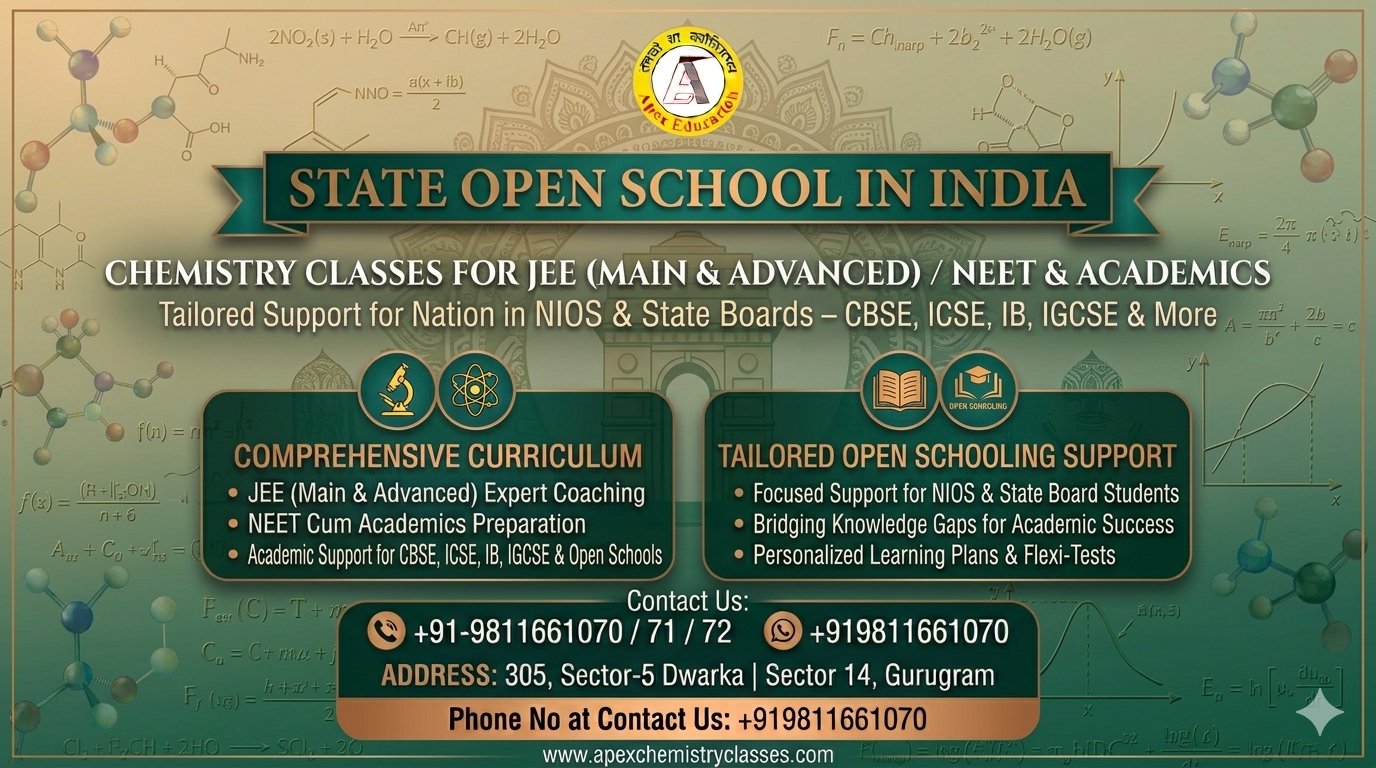
Complete Guide to State Open Schools in India: Balancing Flexible Schooling with Premier JEE & NEET Preparation
State Open Schools (SOS) across India have transformed secondary and higher secondary education by providing flexible, accessible, and legally recognized alternatives to conventional formal boards. Historically viewed primarily as a second-chance mechanism for non-traditional students, open schooling has evolved into an intentional academic strategy. Today, thousands of ambitious science stream students choose State Open Schooling to bypass the rigid, attendance-heavy routines of regular schools, allowing them to channel their time and intellectual energy into competitive engineering and medical entrance tests like JEE Main, JEE Advanced, and NEET UG.
Navigating open schooling while simultaneously mastering advanced physical, organic, and inorganic chemistry requires a structured academic framework. At Apex Chemistry Classes, an elite initiative under Apex Education, led by Ashok Kumar Yadav (Ashok Sir), we deliver the comprehensive, synchronized mentorship required to master both open school theory and competitive entrance papers. If your goal is to secure high percentages in your state open school examinations while securing top-tier ranks in national examinations, partnering with the Best coaching for JEE / NEET cum Academic for Dwarka, Janakpuri, Kalkaji, Gurugram and Delhi NCR ensures you reach that milestone.
Understanding Open Schooling in the Indian Education Framework
Open and Distance Learning (ODL) at the school level is governed by state-level and national bodies designed to democratize education without compromising academic rigor.
1. National Level vs. State Level Open Schooling
- NIOS (National Institute of Open Schooling): Operating under the Ministry of Education, Government of India, NIOS is the national-level autonomous organization catering to secondary and senior secondary learners across all states and union territories.
- State Open Schools (SOS): Modeled after NIOS and established under state legislative acts or executive orders, State Open Schools function under their respective state governments’ school education departments. They design independent curricula, print learning materials in regional and national languages, hold dedicated examinations, and issue certificates recognized across India.
2. Legal Equivalency and National Recognition
A persistent misconception among parents and students is that open school qualifications carry lower legal weight than regular certificates from boards like CBSE, CISCE, or regular state examination bodies.
- Equivalency Status: Certificates awarded by recognized State Open Schools are considered equivalent to formal secondary and higher secondary boards by the Association of Indian Universities (AIU) and the Council of Boards of School Education in India (COBSE).
- Entrance Eligibility: National bodies conducting entrance exams—including the National Testing Agency (NTA) for JEE Main and NEET, as well as the Joint Admission Board (JAB) for JEE Advanced—treat recognized State Open School senior secondary certificates as eligible qualification credentials, provided minimum criteria such as aggregate marks, specific subject groupings (Physics, Chemistry, Mathematics/Biology), and age prerequisites are met.
Comparative Matrix: Conventional State Boards vs. State Open Schools
| Parameter | Conventional State Boards (BSEB, UPMSP, MPBSE) | State Open Schools (BBOSE, UPSOSB, MPSOS, RSOS) |
|---|---|---|
| Attendance Mandate | Strict minimum attendance requirements (typically 75%). | No daily classroom attendance requirements; highly flexible self-study. |
| Pacing & Examination | Fixed, single-attempt annual schedules. | Bi-annual examination sessions with on-demand and flexible sittings. |
| Credit Accumulation | Clear all subjects within specified regular sittings. | Accumulate passing credits across multiple examination cycles (up to 5 years). |
| Transfer of Credit (TOC) | Generally not applicable between failed subjects. | Available to transfer passing credits from recognized parent boards. |
| Time Availability for JEE/NEET | Split heavily between school commutes, practical files, and school tests. | Maximized time allocation for focused entrance training and structured problem solving. |
Detailed Analysis of Major Indian State Open Schools
State Open Schools offer unique admissions structures, regional syllabus adaptations, practical exam regulations, and credit-transfer provisions. A comprehensive examination of India’s major State Open Schools clarifies how students can optimize their academic strategies.
1. Bihar Board of Open Schooling and Examination (BBOSE)
The Bihar Board of Open Schooling and Examination (BBOSE) is an autonomous organization established under the Department of Education, Government of Bihar. It addresses the educational needs of diverse student cohorts across both rural and urban Bihar.
       BBOSE Academic & Operational Workflow
  ┌──────────────────────────────────────────────┐
  │         Direct Admission Sessions            │
  │     Session 1 (June) & Session 2 (Dec)       │
  └──────────────────────┬───────────────────────┘
                         │
                         ▼
  ┌──────────────────────────────────────────────┐
  │     Subject Selection & Study Centers        │
  │  Core Science: Physics, Chemistry, Math/Bio  │
  └──────────────────────┬───────────────────────┘
                         │
                         ▼
  ┌──────────────────────────────────────────────┐
  │       Practical Assessments & PCPs           │
  │  Mandatory Laboratory Attendance at Centers  │
  └──────────────────────┬───────────────────────┘
                         │
                         ▼
  ┌──────────────────────────────────────────────┐
  │      Bi-Annual Evaluation & Certification    │
  │     Equivalency via COBSE & AIU Frameworks   │
  └──────────────────────────────────────────────┘
Curriculum & Textual Framework
- Syllabus Architecture: BBOSE mirrors the senior secondary framework aligned with national expectations, organizing Chemistry, Physics, and Mathematics/Biology into sequential modules.
- Medium of Instruction: Learning resources and exam papers are delivered in Hindi and English, facilitating easy transitions for students switching from the conventional Bihar School Examination Board (BSEB).
- Practical Component: Chemistry and Physics demand practical project submissions alongside laboratory evaluations conducted at authorized study centers.
Key Policies
- Examination Cadence: BBOSE typically conducts public examinations twice a year (June/July and December/January), giving learners dual opportunities to improve scores or clear remaining subjects.
- Transfer of Credit (TOC): Students who fail regular BSEB Class 12 exams can transfer up to two passed subjects into the BBOSE system, preserving their progress.
Academic Considerations for JEE & NEET Aspirants
BBOSE provides science learners flexibility, but self-study study modules can leave conceptual gaps in theoretical derivations and chemical reaction mechanisms. Students require high-caliber support from the Best Chemistry coaching for JEE / NEET cum Academic for Dwarka, Janakpuri, Kalkaji, Gurugram and Delhi NCR to master structural and analytical problem-solving.
2. Uttar Pradesh State Open School Board (UPSOSB)
The Uttar Pradesh State Open School Board (UPSOSB) offers distance education pathways across India’s most populous state, bridging educational access for students outside formal secondary schools.
Curriculum & Textual Framework
- Content Mapping: UPSOSB organizes senior secondary science around national core standards, using the NCERT model to maintain conceptual parity with the main UPMSP board.
- Chemistry Curriculum: Covers core topics in Physical Chemistry (chemical kinetics, electrochemistry, solutions), Inorganic Chemistry (p-block, d-block, coordination chemistry), and detailed Organic pathways.
Key Policies
- Credit Accumulation Window: Learners are granted an extended window (up to five years across consecutive sessions) to complete their senior secondary certificates.
- Laboratory Training: Science candidates must complete mandatory contact sessions at designated study centers to earn practical credits.
Strategic Relevance for Competitive Aspirants
Because the UP curriculum aligns with national standards, UP open school students are well-positioned for competitive exams. However, regular academic supervision is vital to maintain consistent study habits without the external pressure of daily school attendance.
3. Madhya Pradesh State Open School (MPSOS)
The Madhya Pradesh State Open School (MPSOS), operating from Bhopal, is one of the most organized and technologically advanced open schooling platforms in Central India.
Key Initiatives and Structure
- “Ruk Jana Nahi” Scheme: MPSOS runs the targeted Ruk Jana Nahi scheme, allowing students who did not clear conventional MPBSE board exams to continue without losing an academic year.
- Evaluation Integrity: MPSOS utilizes centralized evaluation protocols, secure online enrollment, and standardized test centers across MP districts.
Science Syllabus and Practical Assessments
- The MPSOS senior secondary science syllabus maps closely to the MPBSE and NCERT frameworks.
- Chemistry involves numerical evaluations in thermodynamics and equilibrium, descriptive questions in coordination chemistry, and laboratory-based qualitative and quantitative analyses.
Bridging Open School and Competitive Ranks
While MPSOS frees students from the burden of 75% classroom attendance, clearing national cutoffs requires deep application skills. Enrolling with the premier coaching for JEE / NEET cum Academic for Dwarka, Janakpuri, Kalkaji, Gurugram and Delhi NCR helps students turn extra study time into higher percentiles.
4. Rajasthan State Open School (RSOS)
Headquartered in Jaipur, the Rajasthan State Open School (RSOS) provides an autonomous framework established by the Government of Rajasthan.
Curriculum & Testing Framework
- Bi-Annual Examination Window: Conducts public exams in March-May and October-November.
- Credit Preservation: Allows students five continuous years and nine attempts to clear five subjects, including practical science modules.
- Textual Foundation: Study materials are modeled on the national open framework and translated to accommodate regional and English-medium learners.
The Rajasthan Open School Advantage
Rajasthan—specifically Kota and Jaipur—is a prominent center for engineering and medical preparation. Many aspirants enroll in RSOS as a compliant, recognized schooling option, using the flexibility of open schooling to focus entirely on entrance examinations. However, without dedicated personal mentors, students can fall behind on fundamental board descriptive writing.
5. Punjab State Open School (PSOS)
Operating under the Punjab School Education Board (PSEB), the Punjab State Open School (PSOS) provides access to secondary and senior secondary credentials for learners throughout northern India.
Operational Profile
- Linguistic Mediums: Instruction and examination papers are provided in Punjabi, Hindi, and English.
- Science Stream Constraints: Laboratory evaluation requirements mean science stream admissions depend on available infrastructure at designated government senior secondary schools functioning as study centers.
Strategic Positioning
PSOS offers a viable option for students in Punjab who want to avoid daily school travel and focus on competitive preparation. It demands consistent self-discipline, especially in mathematically complex subjects like Physical and Organic Chemistry.
6. Haryana State Open School (HOS)
Operating under the Board of School Education Haryana (BSEH) in Bhiwani, the Haryana Open School (HOS) provides distance education across Haryana and borders the Delhi National Capital Region.
       HOS Functional Framework & Benefits
 ┌───────────────────────────────────────────────┐
 │       Geographic Proximity to Delhi NCR       │
 │   Seamless Connectivity to Premium Coaching   │
 └──────────────────────┬────────────────────────┘
                        │
                        ▼
 ┌───────────────────────────────────────────────┐
 │         Admission Category Flexibility        │
 │  Fresh Candidates (CTP) & Re-appear Options   │
 └──────────────────────┬────────────────────────┘
                        │
                        ▼
 ┌───────────────────────────────────────────────┐
 │     NCERT Alignment for Senior Secondary      │
 │ Physics, Chemistry, Biology/Math Direct Sync  │
 └──────────────────────┬────────────────────────┘
                        │
                        ▼
 ┌───────────────────────────────────────────────┐
 │     Combined Academic & Entrance Mastery      │
 │  Focus Time Available for JEE / NEET Prep     │
 └──────────────────────────────────────────────┘
Curriculum & Alignment
- Direct NCERT Alignment: HOS directly mirrors the curriculum, exam design, and textbook conventions of regular BSEH board exams, which are aligned with the national NCERT curriculum.
- Dual Exam Cycles: Public examinations run alongside regular board exams in March and October/November.
Proximity to Delhi NCR Coaching Centers
Because HOS operates throughout districts adjacent to the national capital—including Gurugram, Faridabad, Sonipat, and Jhajjar—it is popular among students preparing for competitive entrance exams. Students leverage HOS’s flexible attendance to attend the Premier chemistry coaching for JEE / NEET cum Academic for Dwarka, Janakpuri, Kalkaji, Gurugram and Delhi NCR.
7. Overview of Other State Open Schools
- West Bengal Council of Rabindra Open Schooling (WBCROS): Delivers secondary and higher secondary education across West Bengal. Emphasizes foundational science while accommodating students working outside traditional academic environments.
- Andhra Pradesh Open School Society (APOSS) & Telangana Open School Society (TOSS): Highly organized open schooling models in southern India. Both boards offer structured science streams with strict practical assessment requirements, mirroring their state intermediate boards.
- Maharashtra State Board of Open Schooling (MSBOS): An alternative established to reduce drop-out rates, offering modern curricula with vocational and academic integration.
- Kerala State Open School (SCOLE Kerala): Known for structured public examinations and academic integrity, SCOLE Kerala provides flexible options while maintaining high secondary education standards.
State Open Schooling as a Strategic Route for JEE & NEET
A growing number of top-tier engineering and medical rankers select open schooling deliberately. Understanding the advantages and risks of this approach is essential.
Advantages of the Open School Strategy
- Time Recovery: Eliminates 6–8 hours of daily school transit, assemblies, and non-core periods, freeing up 35–45 hours per week for focused entrance preparation.
- Reduced Burnout: Students avoid the physical exhaustion of balancing daily school homework, unaligned unit exams, and evening coaching classes.
- Synchronized Syllabus Progress: Learners can study complex topics—such as Organic Reaction Mechanisms or Chemical Thermodynamics—deeply and comprehensively, rather than rushing through them to match arbitrary school deadlines.
- Strategic Exam Pacing: Flexible exam sessions let students schedule challenging board papers at times that do not conflict with JEE Main Session 1 or the NEET exam in May.
Critical Challenges
- Lack of Academic Discipline: Without the structure of daily school attendance, unstructured students can fall into procrastination and lose academic momentum.
- Neglecting Subjective Board Exams: Entrance exams rely on speed and multiple-choice elimination tactics, whereas state open schools require detailed, step-by-step descriptive answers and formal laboratory records.
- Limited Laboratory Access: Open school study centers often offer limited hands-on lab time, which can create gaps in practical chemistry and qualitative analysis.
To address these challenges, students need access to the Top coaching for JEE / NEET cum Academic for Dwarka, Janakpuri, Kalkaji, Gurugram and Delhi NCR, where descriptive academic support is directly integrated with entrance training.
Chemistry Mastery: The Linchpin for State Open School and Entrance Success
Chemistry carries equal weight in both board examinations and competitive entrance tests, making it a critical differentiator for science students.
                  Unified Chemistry Strategy
                ┌────────────────────────────┐
                │ NCERT / State Open Module  │
                │  Core Theory & Definitions │
                └─────────────┬──────────────┘
                              │
             ┌────────────────┴────────────────┐
             ▼                                 ▼
┌───────────────────────────┐    ┌───────────────────────────┐
│     Descriptive Focus     │    │     Competitive Focus     │
│   • Step-by-Step Proofs   │    │   • Reaction Mechanisms   │
│   • Named Reactions       │    │   • Shortcut Calculations │
│   • Balance Equations     │    │   • Elimination Tactics   │
│   • Industrial Processes  │    │   • Graphical Solutions   │
└───────────────────────────┘    └───────────────────────────┘
             │                                 │
             └────────────────┬────────────────┘
                              │
                              ▼
                ┌────────────────────────────┐
                │ Complete Academic Mastery  │
                │  Board High % + Top Rank   │
                └────────────────────────────┘
1. Physical Chemistry: From Derivations to Fast Numericals
State Open School papers test foundational derivations—such as the integrated rate equations for zero and first-order reactions, Nernst equation derivations, and colligative property proofs. Conversely, JEE and NEET require quick mental approximations, dimensional analysis, and comfort with multi-step calculations under strict time limits.
2. Inorganic Chemistry: Systematic Organization
Inorganic chemistry is often approached through rote memorization. Under the NCERT and State Open School frameworks, the subject requires a clear understanding of:
- Periodic trends (atomic radii, ionization enthalpies, electron gain enthalpies).
- Valence bond theory, hybridization, and molecular orbital diagrams.
- Systematic coordination chemistry nomenclature, isomerism, and crystal field theory.
3. Organic Chemistry: Understanding Mechanisms
Board examinations frequently ask for direct named reactions (e.g., Aldol Condensation, Reimer-Tiemann, Cannizzaro) along with simple test-tube differentiations. However, competitive exams like JEE Advanced evaluate multi-step reaction cascades, stereochemical inversions, carbocation rearrangements, and inductive/mesomeric stability. Students who only memorize basic definitions struggle when faced with novel reaction conditions.
Solving this challenge requires Top chemistry coaching for JEE / NEET cum Academic for Dwarka, Janakpuri, Kalkaji, Gurugram and Delhi NCR, combining conceptual derivations with deep mechanical problem-solving.
Apex Education & Apex Chemistry Classes: Dedicated Academic Mentorship
At Apex Chemistry Classes, an institution within Apex Education, we specialize in transforming the open school framework into an academic advantage. Our pedagogical methodology is built around the needs of students targeting both high board percentages and competitive entrance ranks.
       Apex Chemistry Classes: Integrated Academic Model
  ┌─────────────────────────────────────────────────────────┐
  │              Foundational Open School Core              │
  │     Clear Explanations • Derivations • Lab Portfolios   │
  └────────────────────────────┬────────────────────────────┘
                               │
                               ▼
  ┌─────────────────────────────────────────────────────────┐
  │             Competitive Scaling Layer                   │
  │    Mechanism Analysis • Numerical Shortcuts • MCQs      │
  └────────────────────────────┬────────────────────────────┘
                               │
                               ▼
  ┌─────────────────────────────────────────────────────────┐
  │                 Dual Assessment Engine                  │
  │   Subjective Tests (Boards) + Timed CBT Mock Tests      │
  └────────────────────────────┬────────────────────────────┘
                               │
                               ▼
  ┌─────────────────────────────────────────────────────────┐
  │            Direct Mentorship under Ashok Sir            │
  │    Individual Tracking • Error Analysis • Confidence    │
  └─────────────────────────────────────────────────────────┘
Leadership & Vision: Ashok Kumar Yadav (Ashok Sir)
The success of Apex is driven by Ashok Kumar Yadav, known to generations of successful medical and engineering professionals as Ashok Sir.
With decades of high-level teaching experience, Ashok Sir has refined a method that demystifies Chemistry for students of all academic backgrounds. Rather than treating Chemistry as an exercise in memorization, Ashok Sir breaks concepts down into fundamental physical and mechanical principles. Under his direction:
- Complex reaction mechanisms become intuitive and predictable.
- Challenging thermodynamic and equilibrium problems are broken down into reliable, step-by-step patterns.
- Abstract inorganic trends are resolved through clear electron-density models.
Ashok Sir provides direct, personal supervision to every enrolled student, offering open school candidates the mentorship and academic structure that independent distance learning typically lacks.
Why Choose Apex for State Open School cum Competitive Success?
1. Dual-Track Curriculum Design
Our courses eliminate the gap between open school requirements and entrance exam demands. Every topic is taught from foundational definitions up to advanced problem-solving. We ensure students can write clear, rigorous subjective answers for board examiners while quickly solving multi-concept entrance problems.
2. Comprehensive Laboratory and Practical Support
State Open Schools require experimental portfolios, project reports, and viva voce preparations. Apex provides dedicated practical guidance, helping students master laboratory procedures, write structured practical files, and score high marks on their internal and external practical assessments.
3. Rigorous Two-Tier Testing Program
- Subjective Assessment Series: Regular written examinations that evaluate step-by-step derivations, clean chemical balance equations, and neat structural drawings, with personalized feedback on presentation.
- Computer-Based Objective Engine: Timed, negative-marking mock exams that replicate the authentic testing interfaces of the National Testing Agency (NTA) for JEE and NEET.
Strategic Learning Hubs Across Delhi NCR
To eliminate long daily commutes and protect your self-study time, Apex Education operates modern, fully equipped centers across major transit hubs in the National Capital Region:
                  Apex Education Learning Network
                                 │
         ┌───────────────────────┼───────────────────────┐
         ▼                       ▼                       ▼
    [ Dwarka Hub ]        [ Janakpuri Hub ]       [ Kalkaji Hub ]
  Metro Interchanges     West Delhi Academic     South Delhi Central
  Blue & Orange Lines    District Hub            Violet & Magenta Lines
         │                       │                       │
         └───────────────────────┼───────────────────────┘
                                 ▼
                         [ Gurugram Hub ]
                    Haryana Board & NCR Corridor
                    Direct Highway Connectivity
- Dwarka: Centrally located near major metro lines, serving learners across West Delhi, Dwarka sub-city sectors, and southwestern entry corridors.
- Janakpuri: Situated in an established academic district, providing easy transit for students using the Blue and Magenta metro corridors.
- Kalkaji: Convenient for South Delhi, Faridabad, and Noida students, with direct access via the Violet and Magenta lines.
- Gurugram: Centered in Haryana’s prime economic corridor, providing convenient, premier coaching for Haryana Open School (HOS) and Delhi NCR students without requiring long daily commutes into the capital.
Subject-by-Subject Strategy: Excelling in State Open Boards & Entrances
1. Chemistry Preparation Strategy
- Physical Chemistry: Master NCERT derivations (Raoult’s Law, integrated rate laws, Clausius-Clapeyron equations) for your open school subjective papers. Simultaneously, practice solving physical calculations without calculators, developing mental math shortcuts to handle logarithmic and exponential operations during JEE and NEET.
- Inorganic Chemistry: Create comprehensive, handwritten reference charts covering coordination complexes, extraction metallurgy steps, and main-group trends. Review these notes regularly to retain fine details for both board questions and objective entrance items.
- Organic Chemistry: Build systematic reaction maps that link functional group transformations, connecting starting materials, reagents, and intermediate products. Ensure you understand reaction mechanisms (electrophilic additions, nucleophilic substitutions, rearrangements) to easily answer both conceptual board questions and complex entrance cascades.
2. Physics Preparation Strategy
- State Open School physics exams emphasize fundamental definitions, standard instrument schematics (e.g., potentiometers, galvanometers, meter bridges), and textbook derivations (e.g., lens maker’s formula, electric field intensities, Bohr model orbits).
- For entrance tests, pivot toward free-body diagrams, circuit reduction techniques, conservation principles, and dimensional approximations to solve unfamiliar composite problems quickly.
3. Mathematics and Biology Preparation Strategies
- For Engineering (Mathematics): State open school math requires clear, step-by-step layout for calculus, coordinate geometry proofs, matrix operations, and three-dimensional vectors. JEE prep demands alternate shortcut methods, symmetry considerations, and rapid value-substitution strategies.
- For Medical (Biology): Master every line and labeled diagram in the NCERT textbooks. Open school assessments require structured physiological descriptions and ecological definitions, while NEET demands absolute recall across all botanical and zoological classifications.
Step-by-Step Roadmap: From Open School Registration to a Top Entrance Rank
       Sequential Action Plan for Open School Candidates
  ┌───────────────────────────────────────────────────────────┐
  │  Phase 1: Registration & Eligibility Verification         │
  │  • Enroll in Recognized State Open School (COBSE Approved)│
  │  • Secure Valid Subject Combinations (PCM / PCB)          │
  └─────────────────────────────┬─────────────────────────────┘
                                │
                                ▼
  ┌───────────────────────────────────────────────────────────┐
  │  Phase 2: Establish Integrated Foundations                │
  │  • Join Apex Chemistry Classes under Ashok Sir            │
  │  • Build Core NCERT Understanding from Ground Up          │
  └─────────────────────────────┬─────────────────────────────┘
                                │
                                ▼
  ┌───────────────────────────────────────────────────────────┐
  │  Phase 3: Dual Testing & Practical Execution              │
  │  • Complete Lab Portfolios & Mandatory Contact Sessions   │
  │  • Weekly Descriptive Tests + Timed Entrance Mock Exams   │
  └─────────────────────────────┬─────────────────────────────┘
                                │
                                ▼
  ┌───────────────────────────────────────────────────────────┐
  │  Phase 4: Targeted Revision & Exam Execution              │
  │  • Clear Open School Theory Exams with 75%+ Aggregate     │
  │  • Complete Entrance Test Cycles with High Percentiles    │
  └───────────────────────────────────────────────────────────┘
- Verify Accreditation: Ensure your State Open School (BBOSE, UPSOSB, MPSOS, RSOS, HOS, PSOS) is recognized by COBSE, the Association of Indian Universities (AIU), and the National Testing Agency (NTA).
- Select Valid Subject Combinations: Register for recognized academic combinations (English, Physics, Chemistry, Mathematics/Biology, and a recognized fifth academic subject) to satisfy JEE Main (75% aggregate or top 20 percentile) and NEET eligibility criteria.
- Establish a Disciplined Daily Schedule: Treat open schooling as a full-time academic commitment. Structure your week with 30 hours of core entrance preparation, 10 hours of descriptive board answer writing, and regular problem-solving practice.
- Complete Practical Modules Early: Attend all mandatory Personal Contact Programmes (PCP), complete your experimental laboratory files, and secure top marks in practical exams.
- Seek Dedicated Mentorship: Work with educators who understand the balance between open school theory and competitive problem-solving. Joining Apex Chemistry Classes gives you access to the expertise of Ashok Kumar Yadav (Ashok Sir), ensuring that every subject area is covered thoroughly and effectively.
Frequently Asked Questions (FAQs)
1. Is a Class 12 certificate from a State Open School valid for JEE and NEET?
Yes. Recognized State Open Schools (such as BBOSE, MPSOS, RSOS, HOS) that are members of the Council of Boards of School Education in India (COBSE) and recognized by the Association of Indian Universities (AIU) are legally valid for national entrance examinations, including JEE Main, JEE Advanced, and NEET UG.
2. How do State Open School students meet the 75% eligibility criteria for JEE Main?
Candidates must score at least 75% aggregate marks in their senior secondary open school board examinations (65% for SC/ST/PwD categories) or rank within the top 20 percentile of their respective board’s passing candidates.
3. Can I transfer passing marks from a conventional board to an open school?
Yes. Most State Open Schools provide a Transfer of Credit (TOC) facility, allowing eligible candidates who did not pass a previous board to transfer credits for up to two passed subjects from recognized parent boards.
4. How does open schooling benefit students preparing for competitive entrance exams?
Open schooling eliminates mandatory daily classroom attendance and long commutes, giving students 35 to 45 additional hours each week to focus on intensive entrance preparation, problem-solving, and timed mock tests.
5. Why is specialized chemistry coaching essential for open school students?
Chemistry connects foundational theory with advanced competitive problem solving. Open school self-study materials may not fully explain complex reaction mechanisms, practical laboratory work, and multi-step physical calculations. Mentorship under Ashok Sir bridges this gap, helping students excel in both descriptive board questions and competitive entrance papers.
Build Your Pathway to Academic and Competitive Success
Choosing a State Open School gives you the flexibility to prioritize your competitive goals, but that flexibility must be matched with clear academic direction. You do not have to compromise your board scores to earn a top entrance rank, nor should you sacrifice your entrance preparation for conventional schooling routines.
At Apex Chemistry Classes and Apex Education, we give you the tools, testing framework, and dedicated mentorship needed to succeed on both fronts. Learn under Ashok Kumar Yadav (Ashok Sir) and realize your full potential across open board examinations, JEE, and NEET.